



Web Design
How to Choose a Web Design Agency in Kurtköy (2026 Guide)
Choosing a web design agency in Kurtköy or Pendik: agency types, evaluation criteria, 7 questions to ask, and what your contract must include.
You want a website built for your business in Kurtköy, or somewhere else in Pendik, and three proposals are sitting in front of you. One is very cheap, one is very expensive, and the third never quite explains what it will deliver. All three use the same words: mobile-friendly, fast, SEO-friendly. Working out which one is the right choice from the proposal text alone is close to impossible.
If you are new to the area: Kurtköy is a neighborhood of Pendik, a district on Istanbul's Asian side, right next to Sabiha Gökçen Airport.
The problem is not a lack of information. It is a lack of criteria for comparison. From the outside, building a website looks like a single product. In reality, very different pieces of work get delivered under the same "corporate website" label, and the difference usually shows up months after launch.
This guide gives you a method for buying. First you will define your own need, then tell the types of provider apart, then test each proposal with seven questions, and finally learn what has to go into the contract. This article is published on an agency's blog, and we are not hiding that. We wrote it so you can apply the same criteria to us.
Key takeaway
The right web design agency is the one that defines the job your site has to do (appointments, quote requests, sales or trust) together with you, delivers speed and SEO foundations in a measurable way, and leaves ownership of the domain, hosting and content with you in writing. When you choose an agency in Kurtköy or Pendik, compare scope, not price: ask every agency the same seven questions, get the answers in writing, and have ownership and post-launch support written into the contract.
Start with your own need: what is your website's job?
Before you talk to any agency, there is one question you need to answer: what should a visitor do after they land on your site? "We want to look professional" is not an answer, because you cannot measure it. "We want this many appointment requests a week" or "we want the quote form filled in" are answers.
- Above the fold: within seconds the visitor should understand what you offer and for whom.
- Call to action: one clear next step for booking, a quote or a call.
- Service and trust blocks: sections that show what you do and why you can be trusted.
- Contact: phone, WhatsApp and a form should be easy to reach from every page.
Illustrative screen built with EAX Studio's own real details.
For a local business, a website usually takes on one of four jobs:
- Collecting appointments. Clinics, beauty centers, hair salons, consultants. The visitor understands the service, trusts you, and calls or messages you on WhatsApp with a single tap.
- Collecting quote requests. Logistics, technology and manufacturing companies in Kurtköy, renovation contractors, auto repair shops. The visitor describes what they need in a few fields, and you get back to them.
- Selling. A product catalog, a cart, online payment. This is the most extensive kind of project and calls for an entirely different budget.
- Confirming trust. The customer has already found you through a recommendation or on Google Maps. They look at the site to answer one question: is this business real, and does it take its work seriously?
A site can do several of these jobs at once, but only one of them is the primary job. The most visible button on your home page leads to that primary job.
| The site's primary job | Sections you cannot skip | How do you measure success? |
|---|---|---|
| Appointments | Service pages, practitioner profile, reviews, fixed call and WhatsApp buttons | Call and WhatsApp clicks, appointment form submissions |
| Quote requests | Service and industry pages, references, a short quote form | Form submissions, email and phone clicks |
| Sales | Product pages, cart, checkout, shipping and returns information | Number of orders, share of visitors who abandon the cart |
| Trust | About, team, certificates, opening hours, location and directions | Direction and call clicks, time spent on the site |
The one-page brief you bring to the agency
Do not walk into the meeting empty-handed. You can write the five points below in half an hour, and when you hand every agency the same text, the proposals come back with comparable scope:
- What does your business do, who does it serve, and which areas do your customers come from?
- What is the site's primary job? Pick one of the four options above.
- Which pages do you think you need? If you are not sure, simply list your services one under the other.
- What do you already have? Logo, photos, text, an existing domain, an old site.
- Two or three websites you like, and why you like them.
Picture a dental clinic that has just opened in Kurtköy. If the owner tells an agency "I want a website," they will receive three proposals with three different scopes and have no way to compare them. If they say "a site that collects appointment requests for implants and orthodontics, with five service pages, using photos we will commission ourselves," every proposal prices the same job.
Which type of provider fits you: ready-made package, custom design, or freelancer?
The providers you come across when you search for web design in Kurtköy fall roughly into three groups. None of them is good or bad in itself. Each one answers a different need, and a mismatch between need and provider is the real source of disappointment.
| Ready-made package or template | Agency that does custom design | Freelancer | |
|---|---|---|---|
| How does it work? | A ready-made theme is filled with your content | The site is planned from scratch around your business and brand | One person, working with a template or with custom code |
| Strength | Starts quickly, low cost of entry | Structure, speed and SEO foundations are shaped around your business | Direct communication, flexible working style |
| What to watch | Theme and plugin weight, limited customization, ownership terms | Longer process, higher budget | Dependence on one person, delays in busy periods |
| Who is it for? | A business with simple needs that has to be online quickly | A business that sees its site as a tool for winning customers | Small, clearly defined jobs, or someone you already know and trust |
| What you should ask | If I leave the package, does the site come with me? | Are scope and schedule in writing? | If I cannot reach you, who holds the logins? |
When is a ready-made package the right choice?
If you have just opened, if all you expect from the site is to show your address, phone number and list of services properly, and if your budget is limited, a ready-made package is a sensible place to start. There is nothing shameful or wrong about using a template. What you need to watch is how much room to move the package leaves you.
Ask about two things up front. When you stop the monthly payment, does the site shut down, or can you take the files and move them somewhere else? And if a separate plugin is installed for every feature added to the theme, who is going to keep an eye on the site's speed?
When does custom design pay off?
If your site is a channel that brings you customers, if your competitors show up in searches in and around Pendik, or if your service is hard to explain, custom design shows its worth. What you are paying for here is not visual decoration. It is structure: which page answers which search, in what order the visitor becomes convinced, how many fields the form has.
The price of custom design is time. A good agency starts with discovery and a content plan, and that pushes back the moment you see a first design by a week or two. More often than not, that delay is a healthy sign.
Working with a freelancer
A capable freelancer can do the work a small agency would do, at the same quality. The risk is not quality, it is continuity. One person can fall ill, take on another job, or change careers.
This risk can be managed: the domain and hosting accounts are opened in your name, all passwords stay with you, and a backup of the site is handed over to you regularly. When those three conditions are met, a freelancer is a perfectly safe option.
What criteria should you use to evaluate an agency?
Every proposal uses similar adjectives. The seven criteria below help you find out whether there is real work behind those adjectives.
Speed and technical foundation
A site that loads slowly loses the visitor before they have even seen the first screen. Google also assesses page experience with three metrics it calls Core Web Vitals. The "good" thresholds for these metrics are fixed and published on web.dev: the largest piece of content appears in 2.5 seconds or less, the page responds to interaction in 200 milliseconds or less, and layout shift stays at 0.1 or less.
You do not need to know the technical detail. What you need to know is whether the agency agrees to measure these values at handover and show them to you. You will find the detail in our article on how website speed affects SEO.
Mobile experience
Visitors to local business sites come overwhelmingly from phones. Open the agency's previous work on your own phone, not on a computer. Can you read the text without zooming in? Can you tap the buttons comfortably with your thumb? Are the call and WhatsApp buttons within reach on every screen?
If the design presentation is given only on a desktop screen, ask for the mobile view as well. Mobile should not be a shrunken version of the desktop design. It should be thought through separately.
SEO and local visibility readiness
The phrase "SEO-friendly" tells you nothing on its own. These are the concrete pieces that should be in place at handover: a unique title and description for every page, a sitemap, a robots file that guides search engines, structured data (markup that describes your business, your services and your frequently asked questions in a form machines can read), and Search Console and Analytics set up.
On the local side, the name, address and phone number on your site must match your Google Business Profile letter for letter, and the profile must link to the site. When you have a website built in Pendik, stating clearly on the site which areas you serve is a precondition for showing up in local searches. We covered the whole topic in our local SEO guide.
There is also a new layer: AI-powered search tools such as ChatGPT and Gemini. For these tools to cite your business as a source, your content has to be clear, structured, and delivered ready-made from the server. Ask the agency whether it has prepared for this. We explained the concept in our article on what GEO is.
Content: who prepares the text and images?
The place where projects most often get stuck is not design or code. It is content. The design is finished, the site waits for text, and weeks go by. The proposal should state clearly whether copywriting, photography and image editing are included.
If you are going to write the text yourself, ask the agency for a content template: for each page, how many headings, how many paragraphs, which questions to answer. Text written without that template often does not fit the design.
Admin panel
When your opening hours change, when you add a new service, or when you want to replace a photo, you should not have to call the agency. The panel has to be usable by you. The only way to find out is to make a change in the panel with your own hands before handover.
There are three things to look for in a good panel: a preview before publishing, a way to undo a change made by mistake, and a written or video user guide.
Ownership: who owns the domain, hosting and source code?
This is the most important criterion in this guide. Your domain (your site's address on the internet) must be registered in your name, in an account opened with your own email address. If the domain sits in the agency's account and the relationship breaks down, you risk losing the address you have spent years promoting.
For hosting (the server where your site's files live) and source code, things are more flexible, but the rule is the same: whose name they are in, and what will be handed over to you if you part ways, must be in writing. Some agencies grant you the right to use infrastructure they have developed themselves without handing over the code itself. That is an acceptable model, as long as you know about it from the start.
Support and maintenance
Work keeps coming after the site goes live: a form stops working, an update is needed, a page gets added. Find out at the proposal stage which channel support is provided through, how quickly you will get a response, and what is free and what is charged.
Reduce the seven criteria to one question
For every criterion, you can ask the agency the same thing: how will you show me this at handover? A measurement report for speed, screenshots of the installed tools for SEO, account details for ownership, a live trial for the panel. Anything that cannot be shown will most likely not be delivered.
7 questions to ask an agency: what do good and bad answers look like?
Ask every agency the seven questions below, in the same order, and take notes on the answers. The questions are not a knowledge test. The aim is to see how much thought the agency has given to your business and how willing it is to put its promises in writing.
1. How do you define the job my site has to do, and how will we measure success?
What a good answer looks like: The agency asks you questions. It wants to learn who your customer is, how they find you, and which channel your inquiries come through today. Then it lists the actions that will be measured: call clicks, WhatsApp clicks, form submissions. It tells you these measurements will be set up at handover.
What a bad answer looks like: "We will build you a modern, stylish, professional site." The answer describes how the site will look, not what it will do. Measurement is never mentioned, or you are told "we will look at the number of visitors."
2. What technology do you build on, and how will you prove speed at handover?
What a good answer looks like: The agency names the technology it uses and explains why it chose it by relating it to your business. It states which tool it will test speed with, whether on mobile or desktop, and how many measurements it will take. It can show you measurement results from sites it has built before.
What a bad answer looks like: "Our sites are very fast, don't worry." There is no measurement tool, no target and no example. The technology question is brushed aside with "we use the latest technology."
3. What exactly will be ready for SEO and local visibility at handover?
What a good answer looks like: You get an itemized list: page titles and descriptions, a sitemap, structured data, Search Console and Analytics setup, the Google Business Profile link and consistent business information. The agency also tells you what it cannot promise: it does not commit to a specific position, or to the first page within a specific period.
What a bad answer looks like: "SEO is included, we will get you on the first page of Google." An answer that promises rankings is selling a result nobody controls. Another weak answer is when you find out only by asking that SEO will be sold as a separate package after handover.
4. Who will prepare the text and images?
What a good answer looks like: Responsibility is divided clearly. Something like: "We write the text for the service pages using the information we get from you, you provide the photos, and we resize and place them." The date by which content has to arrive is written into the schedule.
What a bad answer looks like: You are told "send us the content and we will put it in," but nobody says how much, in what format, or by when. In the end the project appears to have been delayed because of you.
5. Whose name will the domain, hosting and source code be in, and what do you hand over if we part ways?
What a good answer looks like: "The domain is registered in your name and in your account. Hosting is managed in this way. If you want to leave, we hand over these items within this period." The answer comes without hesitation, and the agency offers to write it into the contract.
What a bad answer looks like: "We take care of all that, you don't need to deal with it." It sounds reassuring, but the question of whose account the domain is in has gone unanswered. If you see discomfort when you press the point, make a note of it.
6. Will I be able to update content myself after launch?
What a good answer looks like: The agency shows you the panel, or shares its screen from the panel of an earlier project. It separates the areas you can change yourself from those that need a developer. It tells you that training and a user guide will be provided.
What a bad answer looks like: "If you need anything, just write to us and we will sort it out." This works for the first few months. After that, every small change can turn into a wait and an invoice.
7. How do post-launch support and maintenance work, and what is included?
What a good answer looks like: The period, the scope and the channel are all defined. The agency explains that errors are fixed free of charge during the initial period after handover, how maintenance is priced after that, how often backups are taken, and how quickly requests get a response.
What a bad answer looks like: "We are always here for you." It may be sincere, but it is not a commitment. If response time and scope are not defined, you will have nothing to hold on to on the day something urgent happens.
Ask for the answers in writing
After the meeting, send the agency a short email: could you summarize what we discussed under these seven headings? A good agency will already have written this into its proposal. A promise that is never put in writing may not be remembered when it is time to sign the contract.
How do you compare proposals side by side?
Comparing three proposals by looking at the total price line means weighing three different jobs on the same scale. Level the scope first, then look at the price. Draw the table below on a blank sheet and fill it in for each proposal.
| Comparison row | What do you write down? | Why does it matter? |
|---|---|---|
| Number and type of pages | Which pages, how many service pages | A one-page site and a multi-page site are not the same job |
| Design approach | Template or custom | It sets the limits of customization and the speed risk |
| Content | Who handles text and images | The largest item of hidden workload |
| Speed commitment | Is there a measurement tool and a target | It makes the word "fast" something you can check |
| SEO deliverables | Is there an itemized list | It prevents add-on packages that appear later |
| Admin panel | Is there one, and is training included | It determines your day-to-day independence |
| Ownership | Who holds the domain, hosting and code | It determines what happens on the day you leave |
| Annual costs | Domain, hosting, maintenance | It shows the cost of three years, not just the first |
| Support | Period, channel, response time | It determines your experience after handover |
| Schedule | Stages and delivery date | It makes clear who is responsible for a delay |
Every cell that stays empty in the table is a question you need to ask the agency. If a proposal leaves a lot of cells empty, that proposal is not cheap. It is incomplete.
Run the decision in five steps
Write down the need
Put the site's primary job, the list of pages and the material you already have on a single page.Ask for three proposals
Send the same brief to three providers. If you can, pick them from different types so you see the range of options.Ask the seven questions
In every meeting, ask the same questions in the same order and take notes on the answers.Fill in the table
Level the scope row by row and ask for more information on the empty cells.Call a reference
Talk to a client of the leading agency about what happened after handover, then decide.
What determines the price of a website?
We do not quote amounts in this article, because any figure given for a job with an unknown scope would be misleading. Knowing what pushes the price up or down, on the other hand, makes proposals easier to read.
- The job the site has to do. A few pages that introduce your business and a site that takes online appointments, carries a product catalog or accepts payments are not the same amount of work. Function sets the price more than the number of pages does.
- How original the design is. There is a serious difference in workload between adapting a ready-made theme and designing an interface specifically for your brand.
- Content production. If copywriting, photo or video shoots, or image production are included, the budget goes up. If they are not included, that work falls to you.
- Number of languages. A second language means more than translation. It means a separate page structure and separate SEO settings. It comes up for hotels around Sabiha Gökçen Airport and for Kurtköy companies that do business abroad.
- Admin panel. Setting up an off-the-shelf panel and developing a panel specifically for your business are different line items.
- Integrations. An appointment system, a payment gateway, customer management software, map and review connections.
- Migrating the existing site. Redirecting old addresses to the new pages and transferring content is a separate job. If it is skipped, your existing visibility suffers.
- Ongoing costs. Hosting, domain renewal, maintenance and optional SEO work are annual or monthly items.
What does the lowest proposal leave out?
When you see a proposal that is noticeably lower than the others, look for the missing lines, not at the price. More often than not, content, SEO setup, panel training or the second year's hosting fee is out of scope. Once those items are added later, the total can end up above the mid-priced proposal.
Which clauses must be in the contract?
In small businesses, website projects are often run without a contract, over messaging apps. When the work goes well, that causes no problems. When a disagreement arises, memory is all you have left. A written text, however short, protects both sides.
- ✓Scope: the list of pages, the functions and every deliverable, written out item by item
- ✓Schedule: the stages, the delivery date and how the schedule shifts if content arrives late
- ✓Payment plan: how much is paid at which stage
- ✓Revisions: how many rounds of design changes are included and how further rounds are charged
- ✓Ownership: who owns the domain, the hosting account, the design files and the content
- ✓Access: a commitment that all usernames and passwords will be handed over
- ✓Exit terms: what will be handed over, and within what period, if the work ends or the relationship breaks down
- ✓Annual costs: the renewal terms for the domain, hosting and maintenance
- ✓Support: the period of free error fixing, the response time and the communication channel
- ✓Personal data: where form data is stored, and who prepares the cookie notice and the privacy notice
The last item is left out of most proposals. If a form on your site collects names, phone numbers or email addresses, you have obligations under KVKK, Türkiye's personal data protection law. Consult a lawyer about the content of the legal texts. The agency's job is to make sure those texts sit in the right place on the site and that cookie preferences actually work on a technical level.
Reading a contract can feel tedious. Even so, make sure you read the "out of scope" section before you sign. Instead of assuming a piece of work is included, check whether it is written down.
How do you review references and case studies?
The screenshots in an agency's portfolio show you only its taste. To find out whether a site does its job, you have to dig a little deeper.
Open the site on your phone. Look at the live site, not at the image on the portfolio page. Act like a customer: find the service and move toward the appointment or quote step. How many taps did it take you to get there?
Take your own measurement. Paste the site's address into Google's free PageSpeed Insights tool and look at the mobile result. How consistent the tool's result is with what the agency told you says a lot about the agency's discipline around measurement.
Pay attention to how the case study is written. A good case study describes the goal, the scope, the work done and the measured result as separate things. If it also says how the results were measured, that is a good sign. Be cautious with unsourced sentences such as "sales multiplied."
Talk to a client. There is only one thing you need to ask: what happened when you asked for something after handover?
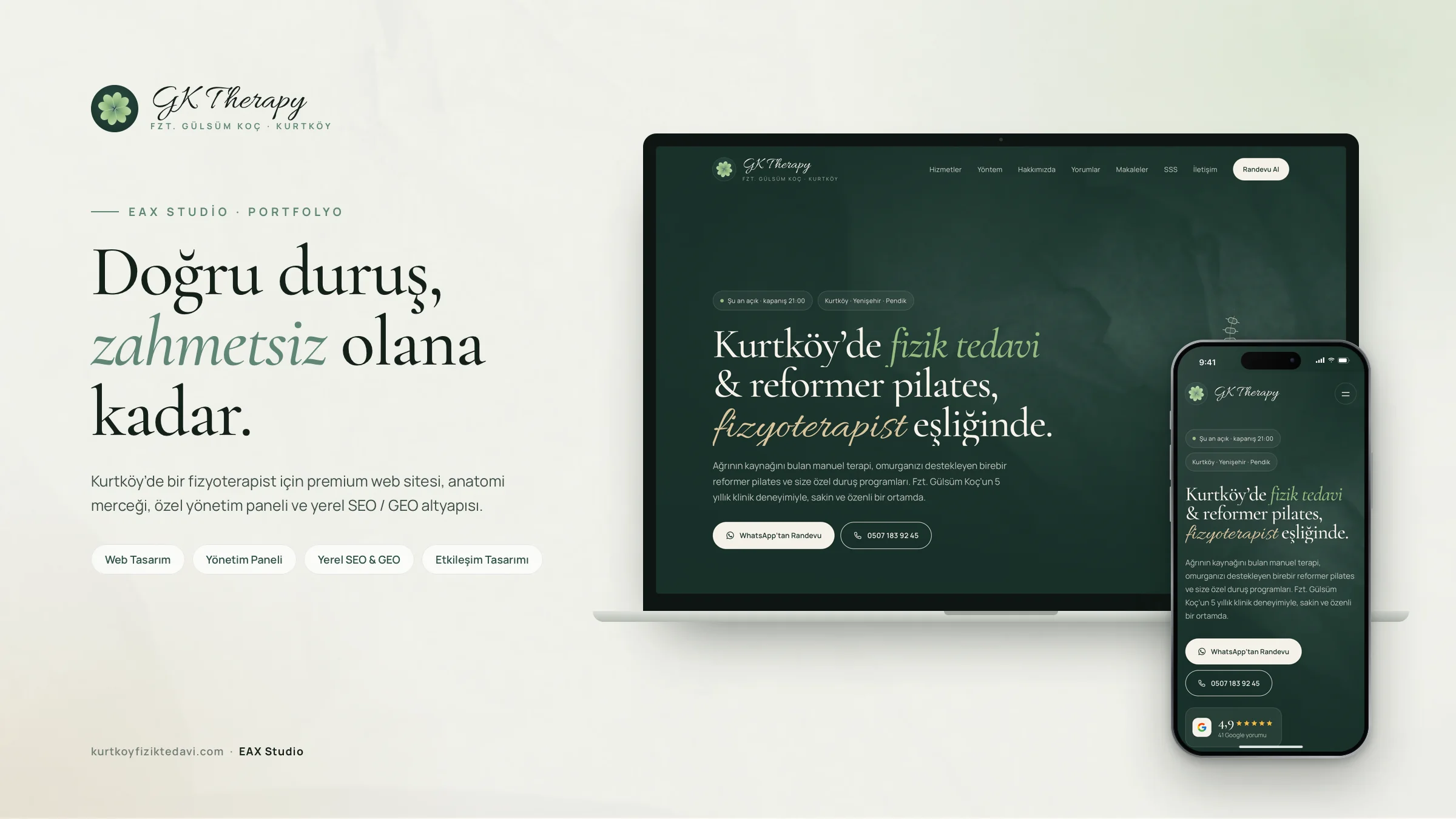
You can look at our own work through the same lens. The site we built for GK Therapy, which offers physiotherapy and reformer Pilates in Kurtköy, was built from scratch to replace an old domain that had expired. The case study page states the scope, the goal and the Lighthouse measurements: a performance score of 96 on mobile and 99 on desktop. The client manages contact details, opening hours, services and articles themselves from a custom panel with 15 sections.
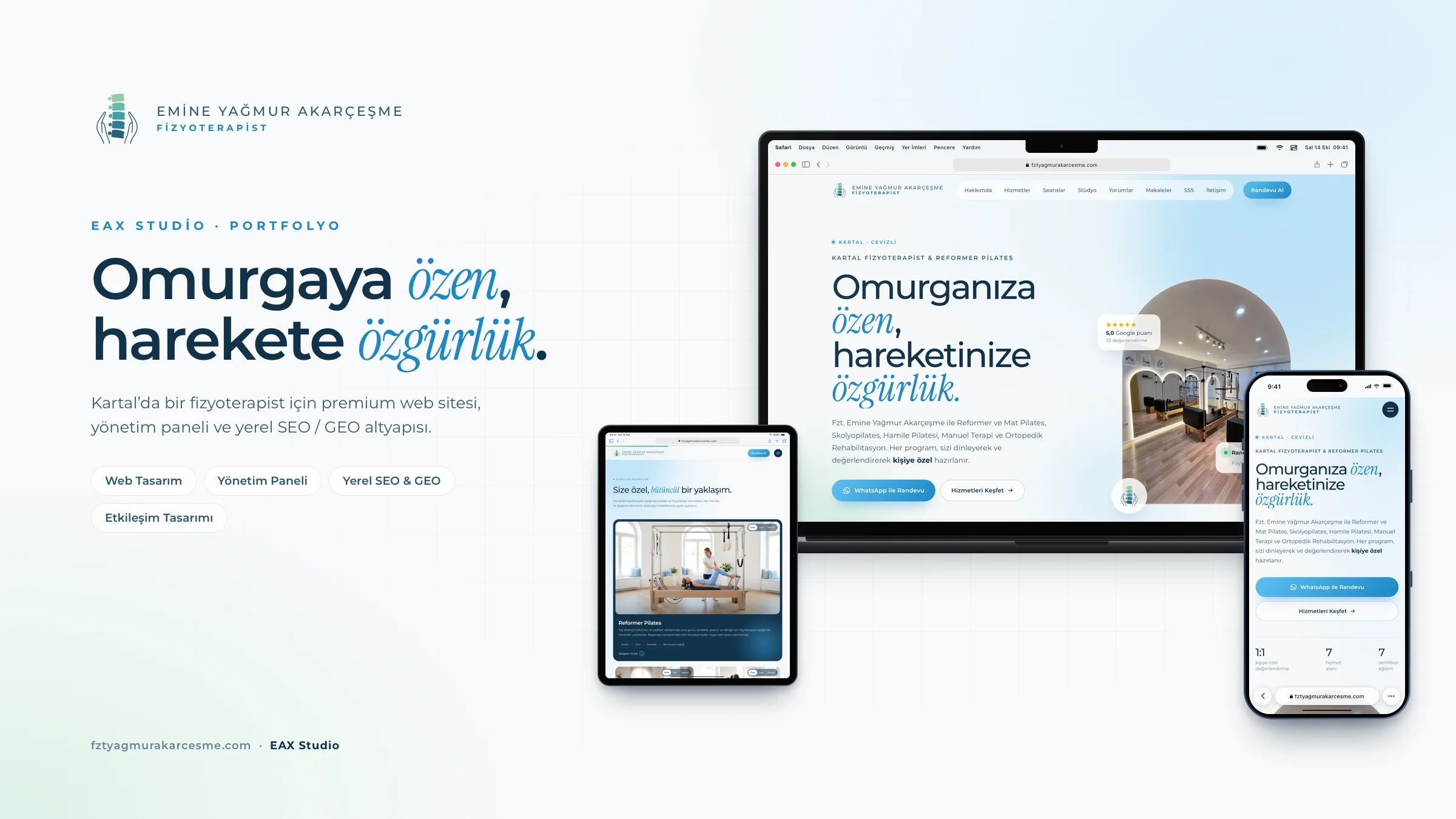
On the Fzt. Emine Yağmur Akarçeşme site, built for a physiotherapist working in Kartal, another district on Istanbul's Asian side, the visitor picks the area that hurts on an interactive pain map, and the site suggests a suitable service and generates a ready-made WhatsApp appointment message. Under the measurement table, the page states how many measurements the median was taken from and which devices were used for testing. In both cases the scores are lab measurements, not a promise of rankings or revenue. For other projects, see our work page.
What should happen in the first 90 days after handover?
Launch day is a beginning, not an end. It takes time for search engines to crawl and assess a new site, and the first real visitor data only builds up over weeks. With a good agency, the first three months go more or less like this.
Launch week
Handover and access
All account details are handed over to you and you receive panel training. Forms, call buttons and WhatsApp buttons are tested on a real phone.Weeks 1–2
Indexing and links
The sitemap is submitted to Search Console and the website address on your Google Business Profile is updated. If there was an old site, the redirects are checked to confirm they work.Weeks 3–4
A first look at the data
You review which pages are getting visits and how many call and form clicks have come in. Broken links and typos are cleaned up.Month 2
Content and small fixes
Questions that visitors ask are added to the frequently asked questions. Buttons that get few clicks are moved or reworded.Month 3
Review
Using the data from the first three months, you discuss whether the site is doing its primary job. The scope of ongoing maintenance and SEO work is set accordingly.
There are things for you to do in this period too. Make at least one change a month in the panel so you do not forget how to use it. When calls come in, ask "how did you find us?" and write down the answers. Keep the site and your Google Business Profile up to date together, because the two are assessed together in local searches.
Do not expect a jump in rankings in the first 90 days. A new site's visibility builds up through content, reviews and time. The right expectation for this period is that measurement works and the site has no technical problems.
Which signs are red flags?
None of the signs below is enough on its own to kill the deal, but each one means you should ask for an explanation. If several appear together, look at another proposal.
- A ranking guarantee. A promise such as "first position in three months." Google decides search results, and no agency can guarantee a specific position.
- The domain staying in the agency's account. Whatever the justification, your address must be in your own account.
- A proposal that does not spell out the scope. A one-line "corporate website package" and an amount.
- An agency that asks no questions. Someone who quotes a price without asking about your business, your customer and your goal is selling a ready-made mold.
- No live examples. Only screenshots or design files are presented, and no sites that are actually online are shared.
- A request for full payment up front. Staged payment keeps both sides motivated to finish the job.
- Avoiding measurement tools. Analytics and Search Console setup is waved away with "you don't need it."
- A pressing deadline. Pressure along the lines of "this price is only valid today." A sound decision can wait a week.
- A sharp reaction to the exit question. Asking about ownership and exit terms is natural, and it should not cause discomfort.
Common mistakes when choosing an agency
Red flags are on the agency's side. The mistakes below are the ones business owners often make on their own side.
Choosing on price alone. The lowest proposal usually has the narrowest scope as well. Do not compare prices before you have leveled the scope.
Judging the design by your own taste. The site has to convince your customer, not you. Instead of "I like how it looks," ask "will my customer find what they are looking for?"
Leaving content until the end. If the text and photos are not ready, even the best design stays empty. Start on the content as soon as the project begins.
Skipping the contract because you know the person. Close relationships are the ones that most need a written text, because it is harder to talk when a problem comes up.
Wanting to put everything on the home page. The urge to fit every service, every photo and every announcement onto the first screen leaves the visitor not knowing what to do.
Thinking the site is a solution on its own. Your site is one part of your visibility in local search. Without a Google Business Profile, reviews and content about the areas you serve, it will struggle to bring in customers by itself.
Forgetting the site after launch. Opening hours that have not been updated in months, services you no longer offer and old campaigns all erode trust.
Not naming a decision-maker. If five people comment on the design separately, the project drags on and the result satisfies nobody. One person should have the final say.
Terms you will come across in proposals
- Domain
- Your site's address on the internet. It is renewed annually and should be registered in your name, in your own account.
- Hosting
- The server service where your site's files are stored and served to visitors. Its quality directly affects the site's speed and availability.
- SSL certificate
- The security layer that encrypts the connection between the site and the visitor. You can see it as the padlock icon in the address bar.
- Admin panel (CMS)
- The interface that lets you change the text and images on your site without knowing how to code.
- Core Web Vitals
- The three metrics Google uses to measure page experience: loading speed, response time to interaction, and visual stability.
- Structured data
- Markup that describes your business, your services and your frequently asked questions in a form search engines can read directly.
- Sitemap
- A list of the pages on your site, prepared for search engines.
- 301 redirect
- A setting that permanently points an old page address to a new one. It preserves your existing visibility when a site is rebuilt.
- Search Console
- Google's free tool that shows how your site is doing in search. The account should be opened in your name.
The first step you can take this week
Before you start looking for an agency, write your one-page brief: the site's primary job, the list of pages, the material you already have, and two websites you like. If you already have a site, also find out this week whose account the domain is registered in. These two steps raise the quality of every proposal you receive.
If you would like to see how we work, you can compare the scope of our web design service against the criteria in this guide. To go over your current site or your plan together, you can request a free review.
Frequently asked questions
How long does it take to have a website built in Kurtköy?+
Does the agency need to be in Kurtköy or Pendik to build my website?+
Is a site built on a ready-made template a bad site?+
What should I do if my domain is registered in the agency's account?+
Is a website a one-time cost?+
Should SEO be bought separately from web design?+
Will I lose my place on Google if I rebuild my existing site?+
Should I trust an agency that guarantees the first page?+
More posts
Keep reading.
- How Does Website Speed Affect SEO?How site speed affects SEO: Core Web Vitals thresholds (LCP, INP, CLS), seven causes of a slow site with fixes, and a 10-point speed checklist.29 min read →
- How to Get Your Brand Recommended by ChatGPT (A GEO Guide)How to get your brand recommended by ChatGPT, Gemini and Perplexity: entity clarity, quotable content, technical setup and a 90-day plan.35 min read →
- Google Ads vs. Meta Ads: A Comparison for Local BusinessesGoogle Ads or Meta Ads? How they differ for local businesses, which one comes first for your kind of work, and how to measure and split a budget.30 min read →