



GEO
How to Get Your Brand Recommended by ChatGPT (A GEO Guide)
How to get your brand recommended by ChatGPT, Gemini and Perplexity: entity clarity, quotable content, technical setup and a 90-day plan.
A potential customer picks up their phone and types this into ChatGPT: "Can you recommend a dentist in Kurtköy who is good with kids?" What comes back is not ten blue links. It is a single answer made up of a few names and a short reason for each. If your name is in that answer, the conversation starts with you. If it isn't, you never even find out the search took place.
This guide doesn't promise a shortcut into that answer, because there isn't one. Instead, it walks you through the work that is in your hands, in order: defining your brand so clearly that machines can't mix it up, writing content that can be quoted, opening your site to AI crawlers, tidying up the traces you leave outside your own site, and testing the result yourself.
We won't explain GEO (generative engine optimization) from scratch here. If the concept is new to you, start with What is GEO?. If you're wondering how it relates to classic SEO, read our SEO vs. GEO comparison. This page is the hands-on part.
One note before we start: the examples are set in Istanbul, where we work. Kurtköy is a neighborhood in Pendik, a district on the city's Asian side, and Kartal is a neighboring district. Swap in your own city and the steps stay the same.
Key takeaway
AI assistants recommend a brand when they can recognize it clearly, when they find consistent information about it in more than one source, and when they can reach content that answers the question directly. Four jobs get you there: defining the brand as a single, consistent entity, producing quotable content, opening the site to AI crawlers on the technical side, and strengthening your off-site signals. The outcome can't be guaranteed, but it can be tracked with regular testing.
When does an AI assistant recommend a brand?
A brand name in an assistant's answer can come from two different places. Knowing which one is at work tells you where to spend your effort.
The first source is the model's memory. Language models are trained on a very large amount of text collected up to a certain date. Brands that have been written about enough earn a place in that memory. A business that works at neighborhood scale is usually either missing from it altogether or present only as a faint trace. You can't change that memory in the short term. All you can do is leave traces today that will be picked up in future training rounds.
The second source is live web search. When assistants such as ChatGPT, Gemini and Perplexity get a question that is current or local, they often run a web search in the background. They turn the question into one or more search queries, read the pages they find, summarize them, and usually show links to their sources. For a question like "recommend a dentist in Kurtköy," this second route is usually the one that decides the answer, and it is the one within your reach.
- The user types a full question, not just keywords.
- The AI writes a single answer; the brand's details appear inside it.
- The sources behind the answer are listed below. The goal is to be one of them.
Illustrative screen built with EAX Studio's own real details.
Which three conditions does an assistant look for before naming a brand?
The companies behind these assistants don't explain in detail which page gets picked and why. Even so, three conditions keep coming up in practice:
- It has to be able to recognize you. When the assistant sees your name, it should understand which business this is, what it does and where it operates, without confusing it with anything else.
- It has to be able to verify you. The information on your site should appear in the same form in other sources too: your business profile, directories, reviews, pages that mention you.
- It has to be able to quote you. The answer to the question should sit on your page in a form that is clear, short and meaningful on its own, and crawlers should be able to read that page.
The rest of this guide takes those three conditions one by one. Entity clarity covers the first, off-site signals cover the second, and content format plus technical readiness cover the third.
What don't we know?
No AI company publishes the formula behind its recommendations, and the models are updated often. That is why this guide never says 'do this and you will be recommended.' We list the steps that raise the odds of being recommended and that also pay off in classic search and in the eyes of your customers.
How do you decide which questions you want to be recommended for?
"I want to show up in AI" is not a goal. The goal is to be named in specific questions. Start by drawing up a question map, because you will come back to this list at every later step.
The questions your customers ask fall into roughly five types. Each type is answered by a different page or source.
| Question type | Example question | Where the answer needs to live |
|---|---|---|
| Brand question | "What is Example Dental Clinic like, can it be trusted?" | About page, reviews, business profile |
| Category and area | "Recommend a vet in Pendik that is open on weekends" | Service page, business profile, local directories |
| Problem question | "My boiler is leaking water, what should I do?" | Guide article, frequently asked questions |
| Comparison | "Implant or bridge, which one is right for me?" | Comparison article, table |
| Decision criteria | "What determines the price when I have a website built?" | Service page, frequently asked questions |
Where do you collect the list of questions?
The best source is your own phone. For one week, write down the questions customers ask most often on WhatsApp, over the phone and at the counter. People put the same sentences to AI assistants, often in longer and more detailed form.
The second source is the queries report in Google Search Console. It shows which searches your site appears for and lets you pick out the queries phrased as questions. The third source is the reviews on your Google Business Profile. What customers praise you for is a hint about which question you should be recommended for.
A list of fifteen to twenty questions is enough. Next to each question, write two things: which page on your site answers it today, and whether that answer sits in the first two sentences or at the very bottom of the page. Every row with a blank next to it is a content gap.
How do you make your brand clear as an entity?
An entity is a person, organization or place that machines recognize as one distinct thing. If the assistant can't recognize you as an entity, it can't piece together the information about you, and it holds back from recommending you. From the model's point of view, recommending a vague brand means risking a wrong answer.
Use one name and one spelling
One name on the sign, a shortened version on Instagram, the registered company name on invoices, and a fourth version stuffed with keywords on the Google profile. This is the picture we see most often in small businesses. A person understands that these are all the same place. A machine doesn't always.
Pick one brand name and write it with the same letters everywhere. If your registered company name is different, state that clearly once on your About and contact pages, along the lines of "Example Dental Clinic is a brand of the company registered under this name."
Write a one-sentence definition
Define your brand in a single sentence, and use that sentence with the same content on your site, on your business profile and in your social media bios. The pattern is simple: name, area, who you serve, what you offer, and the type of business.
Example Dental Clinic is an oral and dental health clinic in Kurtköy, Pendik, that offers dental treatment for children and adults.
"We add value to your smile" is a slogan, not a definition. Keep the slogan if you like, but put the definition sentence in the first paragraph of your home page and your About page. When assistants describe your brand, they often borrow exactly this kind of sentence.
Spell out your services and your area
Listing your services as bullet points on a single page isn't enough. Each main service should have its own page, and that page should say what the service is, who it suits, how it works and which questions come up most. The page that can answer "children's dentist in Kurtköy" is the one that describes that service plainly in its title and first paragraph.
Don't leave your location as nothing more than an embedded map. Write out in text which districts and neighborhoods you serve. Your opening hours, phone number and booking method should also be readable text, not something locked inside an image.
Take your About page seriously
On most sites the About page is the most neglected one, yet it is one of the first places an assistant looks when it gets a brand question. A good About page answers these questions:
- When was the business founded, and what need did it grow out of?
- Who runs it, and who is on the team?
- Which certificates, licenses and memberships does it hold?
- Which areas does it serve, and who are its customers?
- How can people reach you?
On this page, use verifiable facts instead of inflated adjectives. "The leader in the industry" can't be verified. "A clinic with two dentists serving Kurtköy" can.
Show the founder or the expert
Brands with a real person visible behind them earn trust more easily. Show the name, title, areas of expertise and certificates of the founder or of the expert who delivers the service, along with a verifiable profile such as LinkedIn if there is one. In fields where trust is decisive, such as health, law and finance, details of degrees and professional credentials matter even more.
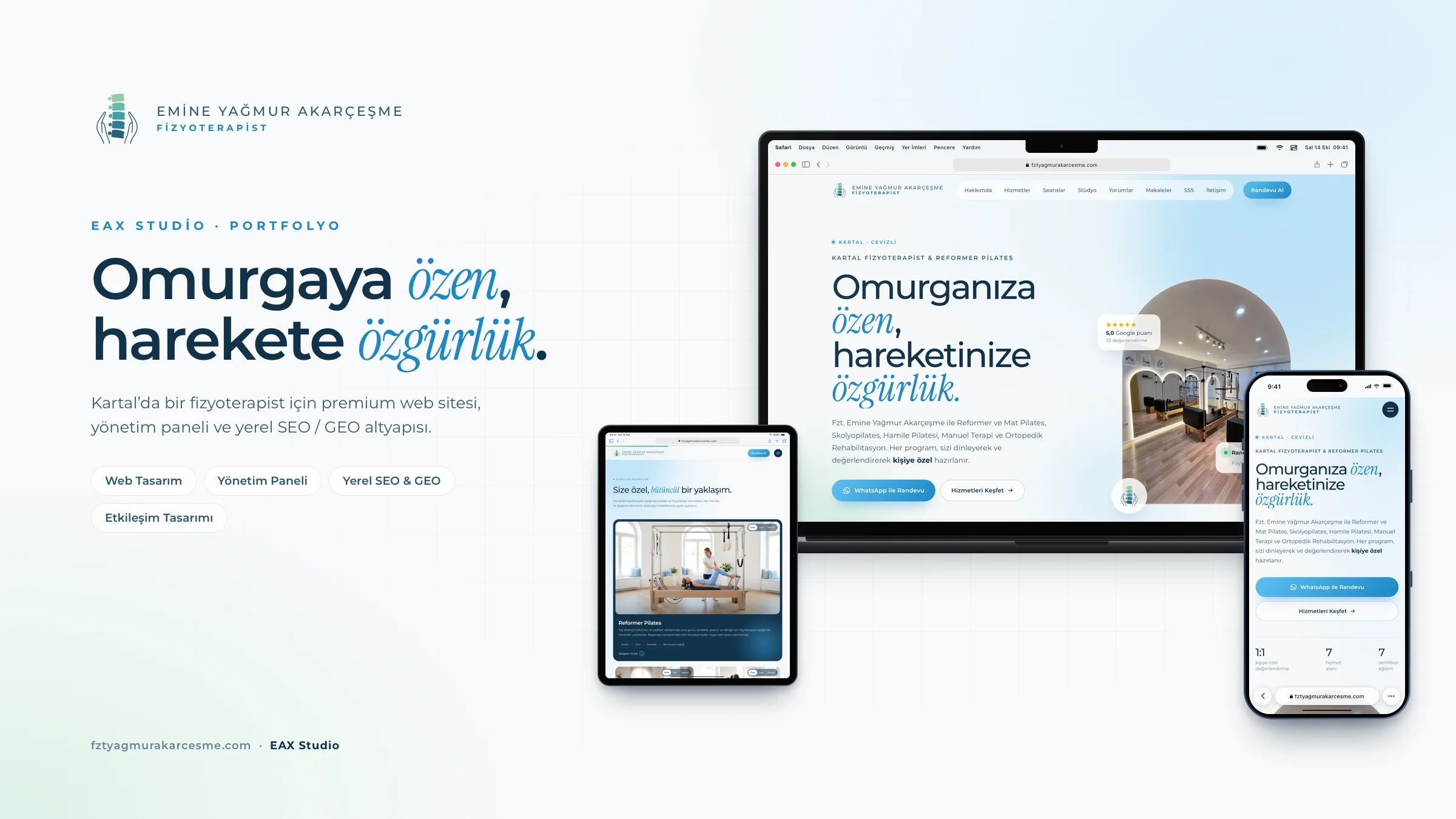
We do the same ourselves: our About page sets out the areas of expertise and certificates of our founder, Emre AZ. On the site we built for a physiotherapist in Kartal, the expert's degree and certificate details were also marked up in structured data. You can see the details in the Fzt. Emine Yağmur Akarçeşme case study.
Link your profiles to each other
Link from your site to your social media and business profiles, and from those profiles back to your site. This two-way link shows that the accounts on different platforms belong to the same business. In structured data, the "sameAs" field does this job. We'll come back to it in the technical section.
- ✓The brand name is written with the same letters on the site, the business profile, social media and directories
- ✓The one-sentence definition appears in the first paragraph of the home page and the About page
- ✓Every main service has its own page, and the page defines the service clearly in the first paragraph
- ✓The districts and neighborhoods you serve are written out as text
- ✓Phone number, opening hours and booking method are text, not part of an image
- ✓The About page shows the name, title and credentials of the founder or expert
- ✓The site and your social media and business profiles link to each other in both directions
Which content formats get quoted?
An assistant doesn't read your page from top to bottom and come away impressed. It looks for the piece inside it that answers the question. If that piece is easy to find and makes sense on its own, the odds of it being quoted go up. Four formats do this job well.
Clear definitions
Make the first sentence of every section answer the question in that section's heading directly. Explanation and detail come afterward. As you write the sentence, test it like this: if it were lifted off the page and read by itself, would it still make sense?
The two sentences below carry the same information, but only the second one can be quoted.
Weak: As we mentioned above, this method is a practice that many of our clients prefer and find very beneficial.
Strong: Reformer Pilates is an exercise method performed on a spring-loaded machine that aims to build muscle strength and postural control.
The first sentence says "this method" and never tells you what it means. The second one names the subject and says what it is and what it is good for.
Question-and-answer blocks
Add a section to your pages made up of questions customers really ask. Write the question in the customer's words, and give the answer in two to four sentences. The first sentence should be the direct answer: "Yes," "No," or a clear fact.
Every question on your question map should be answered somewhere on your site in this form. Instead of piling the questions onto one giant page, spread them across the service pages they belong to.
Comparison tables
Assistants get asked "which one is right for me?" questions all the time. A plain table that compares two or three options against set criteria is easy to scan for readers and machines alike. Add it as a real table, not as an image. Text inside an image usually goes unread.
Under the table, write a decision sentence: "If budget comes first, choose this; if durability comes first, choose that." Assistants like to carry this kind of conditional recommendation into their answers.
Step lists
Break content that describes a process into numbered steps. Questions such as "What happens at the first appointment?" and "How does a repair request move forward?" are best answered with a step list. Each step should describe a single action.
Knowledge only you have
Everyone writes the general information, and the assistant already knows it. What makes you valuable as a source is knowledge that comes from your own experience: the problem you run into most often in your area, the steps of your own working process, the reason you do a job a particular way.
There is nothing wrong with drafting with AI. But a person who knows the work has to correct the draft and add their own experience to it. Uncorrected text that could be found on any site convinces neither the reader nor the assistant.
Technical readiness: can crawlers read your site?
Even the best content might as well not exist if it can't be read. Technical readiness comes down to four areas, and most of them are set up once and checked from time to time.
robots.txt: open the door to crawlers
robots.txt is a small text file that sits in the root directory of your site and says which bot may enter which pages. You can see your own file by typing /robots.txt after your domain name.
AI companies use different bots for different jobs. These are the common ones:
| Company | Bot or token | What it is used for |
|---|---|---|
| OpenAI | GPTBot | Crawling for model training |
| OpenAI | OAI-SearchBot | Appearing in ChatGPT's search results |
| OpenAI | ChatGPT-User | Opening a page when a user asks for it |
| Anthropic | ClaudeBot | Crawling for model training |
| Anthropic | Claude-SearchBot | Crawling for Claude's search answers |
| Anthropic | Claude-User | Opening a page when a user asks for it |
| Perplexity | PerplexityBot | Perplexity's search index |
| Perplexity | Perplexity-User | Opening a page when a user asks for it |
| Google-Extended | Permission to use content in Gemini models | |
| Microsoft | Bingbot | The Bing index and the assistants that rely on it |
Google-Extended is not a separate bot. It is a permission token used inside robots.txt, and it doesn't affect your ranking in Google Search. Google's AI summaries inside search, on the other hand, rely on the regular search index. Bot names and their jobs can change over time, so check the current list against each company's own documentation: OpenAI, Anthropic, Perplexity, Google.
A plain example that allows all of them looks like this:
User-agent: GPTBot
Allow: /

User-agent: OAI-SearchBot
Allow: /

User-agent: ClaudeBot
Allow: /

User-agent: Claude-SearchBot
Allow: /

User-agent: PerplexityBot
Allow: /
If your file contains a "Disallow: /" line for these bots, or a general block that covers all bots, assistants can't read your site. Some hosting and firewall services may block AI bots by default. Even if robots.txt looks clean, take one look at the bot settings in your service's control panel.
Allowing access is a choice
If you don't want your content used for model training, you can close the door to training bots and leave it open to search bots. Just keep this in mind: if you want to be recommended in answers, the bots that crawl for search, at the very least, need to be able to read your site.
llms.txt: a summary of your site for machines
llms.txt is a text file placed in the root directory of your site that summarizes your brand for language models in a plain layout. It usually contains:
- The brand name and the one-sentence definition
- Short descriptions of your services and links to the relevant pages
- Service area, contact details and opening hours
- Links to your most important guide articles
To be honest, llms.txt is a proposal, not an official standard. The big AI companies have made no clear commitment that they use this file in their recommendation decisions. Still, it is easy to prepare, it does no harm, and it forces you to describe your brand clearly on a single page. That is why we set it up, but we don't expect it to deliver results by itself.
Structured data: label who you are
Structured data is a way of marking up the information on a page with labels that machines understand precisely. The shared vocabulary comes from schema.org. For a small business, these are the priority types:
- Organization or local business: name, phone, service area, opening hours, logo
- Person: the name, title and areas of expertise of the founder or expert
- Service: the name and description of each service
- Frequently asked questions: the questions and answers on the page
- Article: the title, author, publication date and update date of the piece
In the "sameAs" field you enter the addresses of your social media and business profiles. That way you state outright that the accounts on different platforms belong to the same entity.
Exactly how structured data affects assistant answers has not been clearly documented. What we do know is this: it helps search engines understand your page and your brand correctly, and assistants that run web searches rely heavily on search indexes. There is only one rule: never mark up information that isn't visible on the page.
Fast pages rendered on the server
Some sites load their content only after JavaScript has run in the browser. A human visitor doesn't notice. But you can't count on every bot running JavaScript. If the content arrives only through JavaScript, the bot may see an empty page.
The fix is to prepare the content on the server and send it as complete HTML. This is called server-side rendering. Testing your own site is easy: right-click the page in your browser, open the page source, and search for a sentence from your main text. If the sentence isn't in the source, bots may not be seeing it either.
Speed belongs under the same heading. Pages that respond slowly or time out can be skipped during crawling. The thresholds considered good for Core Web Vitals, Google's page experience metrics, give you a yardstick: main content load time (LCP) of 2.5 seconds or less, response time to interaction (INP) of 200 milliseconds or less, and layout shift (CLS) of 0.1 or less. For the details, see our article on how website speed affects SEO.
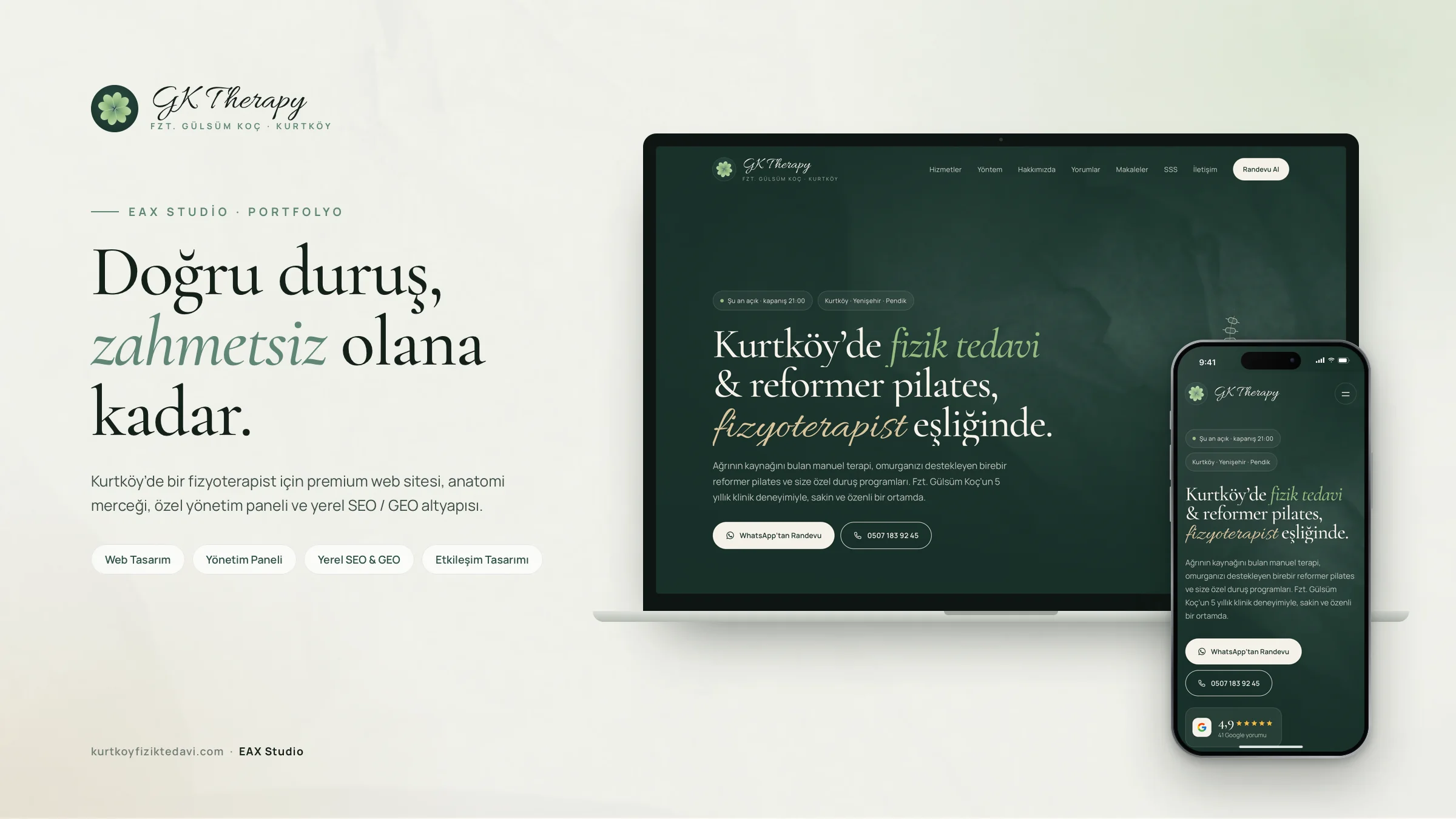
On the site we built for a physiotherapist in Kurtköy, all four of these areas were set up: a robots.txt that is open to AI crawlers, llms.txt, structured data, and complete HTML generated on the server. The details of the setup are in the GK Therapy case study.
Sitemap and search indexes
The web searches that assistants run rely heavily on existing search indexes. So don't skip the classic jobs: an up-to-date sitemap, a Google Search Console registration and a Bing Webmaster Tools registration. The Bing registration is missing at most small businesses, yet some assistants draw on that index for their searches.
Off-site signals: how do others describe you?
What you write about yourself on your own site isn't enough evidence by itself. The assistant compares what you say with other sources. When the same information repeats in several independent places, trust goes up.
| Signal | Why it helps | First step |
|---|---|---|
| Google Business Profile | A verified record that gathers name, category, area, hours and reviews in one place | Fill in the profile completely and put your definition sentence in the description |
| Reviews | They show which service customers associate you with and how they describe you | Ask happy customers to write a review that mentions the service |
| Directories | They confirm that your name, phone and area details are consistent | List your existing records and fix the differences |
| Industry listings | They show your professional identity through an independent body | Update your member page at your chamber, association or professional body |
| Press and mentions | They put your name on pages that are independent of you, alongside your topic | Offer an expert comment or a guest article to a local publication |
Google Business Profile and reviews
For local questions, assistants' answers often resemble map and business profile data. If your profile is incomplete or your category is wrong, it gets harder to be a candidate for a question like "a vet in Pendik that is open on weekends." If you would like to treat profile management as a regular job, take a look at what our Google Business Profile management service covers.
With reviews, content matters as much as count. A review that says "We were very happy" builds trust. A review that says "It was my daughter's first dental checkup, and the dentist talked her through every step" matches you to a specific question. When you ask a customer for a review, you can ask them to mention which service they received. Don't write the text for them, and don't offer anything in return.
Directories and industry listings
Open your records on map apps, business directories and industry-specific platforms one by one. Are the name, phone number and area details the same as on your site? An old phone number, or the area you were in before you moved, is the most common reason an assistant gives wrong information about you.
Member pages at bodies such as professional chambers, associations and trade bodies are small but valuable sources. If you are a member, make sure your record is current and links to your site.
Press and mentions
A mention is your name appearing on another page. Even without a link, having your name brought up alongside your topic leaves a trace. Giving an expert comment to local news sites, writing for a trade publication, and being listed as a solution partner on your business partners' sites are all realistic routes.
Stay away from promotional article packages sold in bulk. Publishing the same text on dozens of unrelated sites doesn't produce trust, and it can conflict with search engines' spam policies.
How do you test your own brand in AI assistants?
You can't improve what you don't measure. You don't need a special tool for this test. A spreadsheet, half an hour and a disciplined method are enough.
Lock the question set
Pick 10 to 15 questions from your question map, write out their wording once and don't change it. You will ask the same questions every month.Open a clean session
Start a new chat for every question. Turn off memory and personalization features if there are any, or use a temporary chat.Ask more than one assistant
Put the same question to at least two or three assistants: ChatGPT, Gemini, Perplexity. Try it separately with web search on and, where possible, with it off.Repeat each question a few times
The same question can produce different answers back to back. Note how many times out of three attempts you were named.Log the result in the sheet
Were you named, in what position, with what reasoning, which source was cited, and is the information correct. Take a screenshot.Repeat once a month
Run the same set with the same method again and put the sheets side by side. Look at the trend, not a single measurement.
Which questions should you ask?
Your question set should include at least two questions of each type. Adapt the patterns below to your own business:
- "What do you know about Example Dental Clinic?"
- "Which services does Example Dental Clinic offer, and what are its opening hours?"
- "Can you recommend a children's dentist in Kurtköy?"
- "Is there a dental clinic in Pendik that is open on Saturdays?"
- "My child is afraid of the dentist. What kind of clinic should I choose?"
- "Should a cavity in a baby tooth be treated?"
- "Implant or bridge, which is the better fit?"
- "Can you compare the dental clinics in Kurtköy?"
In category questions, leave your brand name out, otherwise you are steering the assistant. Do write the area out, though. The assistant doesn't always know your location, and it gives a generic answer when no area is specified.
How should you record the results?
Your sheet should have these columns: date, assistant and model name if shown, whether web search was on, the exact wording of the question, whether you were named, in what position, the reasoning the assistant wrote for you, the sources cited, and whether there was any wrong information.
The last two columns are the most valuable. The cited sources tell you where the assistant got its information. If the source is an old directory record and not your own site, you know exactly what to fix. If a competitor is being recommended, look at which source it is being recommended through. That shows you what you are missing.
Results vary by person and by day
The same question can produce a different answer depending on the account, the chat history, the location, the model in use, whether web search is on, and the day it is asked. Being named on your screen doesn't mean you will be named on your customer's screen. Don't conclude 'we are being recommended' or 'we are not being recommended' from a single screenshot. Look at the trend across repeated measurements.
How do you read the test results, and what can you measure?
The test sheet is a diagnostic tool. The decision table below shows the five situations that come up most often and where to look first in each.
| What you see | Likely cause | First move |
|---|---|---|
| You aren't recognized even in a brand question | The site can't be read or isn't indexed, or the brand name is inconsistent | Check bot access, the page source and your index registration |
| You are recognized but the information is wrong | Old directory records, a profile that was never updated | Find the cited source and fix the record |
| You appear in brand questions but not in category questions | Weak service page, few off-site signals | Write a page dedicated to the service, and strengthen reviews and mentions |
| Your site is cited as a source but your name isn't recommended | The content is informative but isn't tied to the service | Link clearly from guide articles to the service page and add the definition sentence |
| Competitors are recommended and you aren't | The competitor has stronger reviews, listings or content | Study the sources cited for the competitor and get into the same kinds of sources |
What can you look at beyond the test?
In your Analytics reports, you may see the assistants' domain names among your referral sources. That shows you the visitors who came to your site from a link in an answer. Not every visit is labeled this way, so treat the number as a direction, not as an exact count.
The trend in searches for your brand name in Search Console is the second indicator. A person who learns your name from an assistant will often look you up on Google afterward. The third and simplest indicator is asking new customers, "How did you find us?" When you start hearing "ChatGPT recommended you," write it down.
What can't you measure? Today, no dashboard will tell you for certain how many people asked an assistant a question that involves you, or how many answers included your name. You have to accept that uncertainty and move forward with the indicators you do have.
An example scenario: how would a dental clinic in Kurtköy apply these steps?
This scenario is fictional. It was written to show the order of the steps. Picture a dental clinic in Kurtköy with two dentists and a focus on child patients.
The clinic owner runs the first test. In the brand question, the assistant recognizes the clinic but gives the wrong opening hours. In the question "recommend a children's dentist in Kurtköy," the clinic isn't named at all.
The diagnosis comes down to three points. The source of the wrong hours is a directory record that was created years ago and then forgotten. The site has no separate page for pediatric dentistry, and the service appears only as a single line in a list. And the clinic's name is written three different ways: on the sign, on Instagram and on the business profile.
In the first month, the clinic makes its name and definition sentence the same everywhere, fixes the old directory record and checks its robots.txt file. In the second month, it writes the pediatric dentistry page: the steps of the first checkup, the six questions parents ask most often, and a short comparison table. In the third month, it asks happy parents for reviews and gives a local publication a short expert comment on dental care for children.
Because this is fiction, we won't give you a result figure. In real life, here is what you would expect to see at the end of that sequence: first the wrong information gets corrected, then the brand questions become clearer, and being named in category questions comes last and most slowly.
What should a 30-60-90 day plan look like?
Don't try to start everything at the same time. Order matters: readability and clarity first, then content, and off-site signals last. Adding content to a site that can't be read is wasted effort.
Week 1
Baseline measurement
Draw up the question map, lock the question set and run the first test. This sheet is the baseline that every later measurement will be compared against.Days 1–30
Lay the foundation
Make the brand name and the definition sentence the same everywhere. Check robots.txt, the page source, the sitemap, and your Search Console and Bing registrations. Write the About page and the founder details, and add basic structured data and the llms.txt file.Days 31–60
Quotable content
Write a separate page for two or three priority services. Add a clear definition, a question-and-answer section and, where needed, a comparison table to each page. Close the blank rows on your question map.Days 61–90
Off-site signals
Complete the business profile, fix your directory records and build the habit of asking for reviews. Aim to appear in one industry listing and one local publication.Day 90
Second measurement and decision
Ask the same question set again with the same method. Compare the sheets and use the decision table to set the priority for the next quarter.
How much work does this plan take?
The first month's jobs are mostly done once, and they may need technical support. The second month takes writing effort, and it won't turn out well without input from the person who knows the work best, which is you. The third month's jobs need to become habits: asking for reviews and keeping the profile current don't end on day ninety.
We can't promise a definite result at the end of ninety days, and neither can anyone else. With assistants that run web searches, corrections may show up after your pages have been crawled again. Getting into the model's memory means waiting for new model versions, and that can take months.
What are the most common mistakes?
Blocking bots without realizing it. An old robots.txt rule or a default firewall setting makes all your effort invisible. This is the first place to check.
Treating llms.txt as a magic wand. Adding the file and waiting doesn't bring results. llms.txt is a small helper. The real work is content and consistency.
Preparing hidden content for AI. Text that visitors can't see, or pages shown only to bots, go against search engines' spam policies. Whatever you show bots, show people the same thing.
Marking up information in structured data that isn't on the page. Review ratings that don't appear on the site, or services you don't offer, don't build trust. They damage it.
Using a different name and phone number on every platform. This is the most frequent reason an assistant gives wrong information about you. Don't open new records before you have cleaned up the old ones.
Listing services as bullets on a single page. A ten-item list under an "Our Services" heading doesn't answer any question. Priority services deserve their own page.
Publishing uncorrected content in bulk. Dozens of articles written by AI and published unread fill your site with information that can be found anywhere. A small amount of content grounded in experience works better.
Deciding on the basis of one test. A screenshot is not evidence. Whether you are about to celebrate or to worry, you need repeated measurements first.
Dropping classic SEO. Assistants' web searches rely on search indexes. A page that can't be found in search will struggle to make it into an answer. The two kinds of work don't replace each other. They feed each other.
Trusting offers that come with a guarantee. An offer that guarantees "the top spot in ChatGPT" is selling an outcome that nobody controls. What can be promised is the work to be done and regular measurement.
Which mistake should you fix first?
The order is always the same: access first, then consistency, then content. If bots can't read your site, the other nine items have to wait.
A short glossary: the terms used in this guide
- Entity
- A person, organization or place that machines recognize as one distinct thing. When your brand is clear as an entity, the information about you gets pieced together correctly.
- Citation
- When an assistant uses information from your page to build its answer and, in most cases, shows your link as a source.
- Mention
- Your brand name appearing on another page. Even without a link, it is a trace showing that your name comes up alongside your topic.
- robots.txt
- A text file in the root directory of a site that states which bot may enter which pages.
- llms.txt
- A text file, proposed but not an official standard, that presents a summary of the site for language models in a plain layout.
- Structured data
- Markup that labels the information on a page with the schema.org vocabulary so that machines understand it precisely.
- sameAs
- The field in structured data that states the brand's official profiles on other platforms.
- Server-side rendering
- Preparing the page content on the server, not in the browser, and sending it as complete HTML. It lets bots that don't run JavaScript read the content too.
- Crawler
- Software that visits web pages automatically and reads their content.
What is the first step you can take this week?
Set aside half an hour and do three things. Write down the ten questions your customers ask most often. Put those questions to two different assistants, each in a new chat, and log the results in a sheet. Then type /robots.txt after your domain name and check whether AI bots are being blocked.
These three jobs show you where you stand, and they cost nothing. The rest follows in order: the definition sentence, the About page, the service pages, the reviews. If your foundation in local search is weak, reading our local SEO guide first will help you lay the ground that everything described here sits on.
If you would like to go over your test results together, or to leave the setup to us, you can look at what our GEO service covers and book a call for a free analysis.
Frequently asked questions
Is there somewhere I can apply to have my brand added to ChatGPT?+
When will I see results?+
Is this effort worth it for a small local business?+
Do I have to have an llms.txt file?+
If I allow AI bots, won't my content be used without permission?+
An AI assistant is giving wrong information about my business. What should I do?+
I don't have a website, only Instagram and a Google profile. Can I still be recommended?+
I already do SEO. Do I need separate GEO work?+
More posts
Keep reading.
- SEO vs. GEO: The Right Visibility Strategy in the Age of AISEO or GEO? See how they differ, what they share, and which should get your effort first for your type of business, with a decision table.29 min read →
- What Is GEO? Next-Generation Visibility in the Age of AIWhat is GEO? A plain-English guide to how AI search builds answers, how it picks sources, and where a small business should start.34 min read →
- Google Ads vs. Meta Ads: A Comparison for Local BusinessesGoogle Ads or Meta Ads? How they differ for local businesses, which one comes first for your kind of work, and how to measure and split a budget.30 min read →